The Fifth Commandment

As BBC informs Polish Foreign Minister Witold Waszczykowski told German newspaper Bild on Sunday“The previous government carried out a leftist programme there (in the public media). It was as if the world was according to a Marxist model which has to automatically develop in one direction only – a new mixture of cultures and races, a world made up of cyclists and vegetarians who only use renewable energy and fight all forms of religion.”

Behind cycling, vegetarianism, ecology there is a basic care for human health. The understanding should precede implementation of values. This understanding comes together with learning, also with learning about religion. Why the fifth commandment is so hard to accept by the Catholic society? Second grade children, preparing for their First Communion are taught what the Fifth Commandment means, it’s not only about killing directly, it is also about care for health, of a given person and her peers, other people. They are taught this here, in Poland during their religion classes. This is part of this religion, I have been taught the same several years ago.

This is kind of very hard to figure out and accept, for me who has been brought up on traditional Christian values, this lack of understanding of fundamental rules behind Christian faith. The care for nature, for trees, for air, for environment, the respect towards other people life and good-being. Why is all this suddenly wrong? And yet in the name of the said “tradition”. What is traditional in cutting down trees, the plans of which have been just recently announced for Puszcza Białowieska? Why smog and environmental pollution, which are the consequences of cities stacked with overwhelming cars’ presence, should suddenly be understood as traditional Polish values?

Why building in the areas endangered with flood has suddenly become available, while it is obviously unethical and dangerous for human beings in case of inundation? Because flats may become cheapper? For whom and for how long? Vast, unbuilt river valleys are necessary to protect neighbouring settlements from floods. When constructing there, backwater from rain sewage has no place to gather and deluge gets further, produces more damage. This is one of the easiest rules in urban planning, the one which saves a lot of money if properly understood, e.g., successful planning in Bogota, started with creation of urban parks in all the river valleys.

On the other hand conciseness being one of the major features of sustainable and efficient towns, it requires proper care for human’s environment. Being close reduces travels and costs of building and maintenance of infrastructure. It enables walking and cycling, which do not produce fumes and keep people healthy. Bicycles are cheap, so is walking – our conservative party declares care for pourer people. What has the requirement to own a car to do with these announcements? Cycling and pedestrian traffic should be developed not limited, there are many people in Poland who cannot afford a car and its maintenance. Not mentioning that concise and pedestrian and bike friendly cities are also much cheapper in longer term. They require much less cleaning, they are smaller, there is less infrastructure to maintain and it is better served, the everyday car’s influx not leaving its damaging effects. They continue the historic sites, do not move as in a nomad society, leaving spoilt place behind because they got unusable and polluted.

Why the development of renewable energy became a synonyms of lack of values of secular, Western world? While it is absolutely the opposite, this is the expression of care for our planet, the Earth.  This is just absurd. Why the words of a Head of the Catholic Church mean nothing to politicians who say they represent a party who relies on Christian values? Those are not the recent statements only, they have been an important part of the Church teaching for a while – compare Encyclicals Centesimus Annus, chapter 4 or Sollicitudo Rei Socialis, chapter 5 by John Paul the Second.

It looks like the power of lifestyle, of everyday habit, outruns the thinking, rationality and understanding. The custom is stronger than values, than religion, than anything. The origin of these customs having little with Polish tradition, have polluting cars always being there? Did not Queen Bona bring vegetables from Italy here already in the sixteenth century and is there anything wrong about healthy diet? Are Poles not world famous for their hospitality, always welcoming foreigners, even when they were forbidden elsewhere? Have we Polish not loved our beautiful forests or landscape, having so many beautiful poems on them? Is the stupid recent custom and temporary conflict stronger than values, than religion, than anything. Is this really true? An extremely sad conclusion it is.
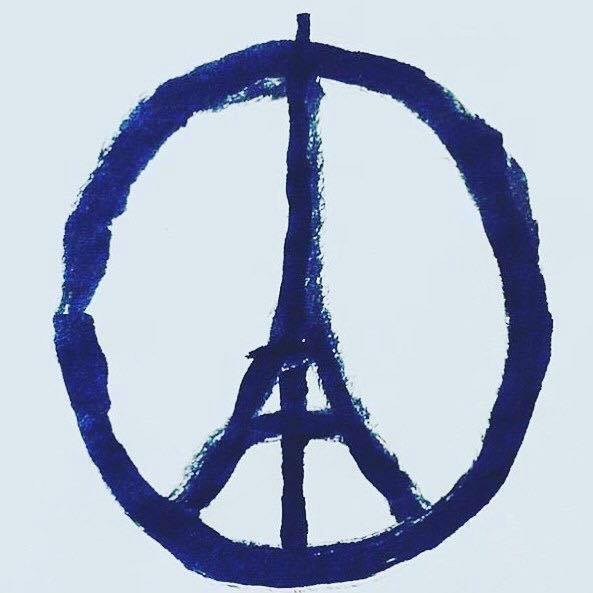
What should come after Paris?

12219537_10206981918319338_4963303265470768049_nThe creator of the drawing is a French artist ‎ #JeanJullien‬
The compassion towards the victims is a feeling which we all share. Our deepest emotions go to the families and friends of those who were killed, we want to express our desire to help. We talk about the need of strength  and the perseverance to overcome the difficult times. All this spreads and slowly we start realising that even if it is the easiest for us to imagine the situation of citizens of the Western and well admired city, like Paris, the war has been started elsewhere. The tragedies of people happen each day, and without eliminating the reasons the consequences may spread even further.

Apart of the political situation which will for sure get its in-depth analyses lots of tensions result from the worsening environmental conditions of regions where current conflicts take place. This environmental danger which rapidly raises as a a follow up of the unpredictable changes in climate conditions makes people fight for shrinking resources. 2015 is to become the first year to crack the halfway mark of 2°C warming, the benchmark that’s been targeted as “safe” climate change.
“A new World Bank report shows that climate change is an acute threat to poorer people across the world, with the power to push more than 100 million people back into poverty over the next fifteen years.  And the poorest regions of the world – Sub-Saharan Africa and South Asia – will be hit the hardest.”

Isn’t this part of the problem? We may only consider such questions rhetorical.

I do hope that the Paris climate talks will succeed in global agreement, also now when the dangers of the consequences of the ongoing changes have suddenly become explicit in so said and regrettable way. The Western world is not really able to remain safe, while horrible things happen elsewhere.

PS. The title is a paraphrase of the one in The NY Times. Don’t you think we should look for solutions and eliminate reasons, not only fight the consequences in the less or more concerted way?

SMOG

smog

We have recently experienced very heavy smog in all the major cities in Poland. In Kraków area, for example, the concentration of PM10 in Nowa Huta exceeded the norm 1200 times, but also the situation in the downtown was very dangerous. Similarly Wrocław, Warsaw and Silesia went through problematic time. Also in Lodz the norms were not kept, the dirt in air was noticeable with blind eye, not mentioning the measure results.

There have been several reasons for this. First of all as it is getting cold the heating season started. Still in many old tenements people use coal as the major fuel, it happens also that some pour families burn rubbish. Second, there are more and more cars in streets. All the former citizens who moved to the suburbs now come back bringing their children to schools and kindergartens, or they just come daily to work. During warmer months some of these people rode their bikes to commute, now as it is getting colder they have switched back to cars. The lack of planning and exaggerated supply of land for construction purposes without proper thinking on the possibilities to serve them with transportation services afterwards, creates huge need for individual solutions. There are no strict norms on cars’ environment friendly exhaust systems. We are probably the largest market in Europe for the used old cars. There are no norms on the fuel quality. Yet not so long ago some municipalities preferred buying coal heaters instead of gas ones because the only requirement they had to fulfil was prize. The current situation is the direct consequence of these deficiencies of legal regulations. Even if very recently the new antismog law has been approved there are still no detailed regulations how to make it work.

All major newspapers write alarming articles but still the discussion shows that there are quite many people who do not see any need for change. They are not affected personally, their families safe from pollution in the suburbs. They come to the town only for few hours a day, park their cars, head towards work and afterwards flee to their refuge. At the same time, we the citizens who want our cities to remain were they are, who do not want to spend larger portions of our days stuck in cars, who want our children to have friends nearby and who simply love living in downtowns or also those of us who cannot afford moving out for various reasons, we must breathe this dirty air, experience cough, stay sick, help our elderly families and care for children when sick, and constantly clean.

Possibly we need more low cost detectors, like in the case discussed by the scientists from the University of Cambridge (below)? Maybe we should engage yet more as activists to fight for clean air to balance the voice of those who are not able to understand that their daily routines affect others? What else may be done? Another solution is just to flee as well.

Fragile things

The title of this entry is inspired by the title of Neil Gaiman’s book containing short fiction stories: http://www.amazon.com/Fragile-Things-Short-Fictions-Wonders/dp/0060515236/ref=ntt_at_ep_dpi_3. I particularly like the one on emperor of China who build a model of his emperium as an island. Just have a look at it – there are many threads closely connected with the considerations on modelling and simulations in urban planning.
“The tale is the map which is the territory. You must remember this. 
There was an emperor of China almost two thousand years ago who became obssessed by the notion of mapping the land that he ruled. He had China re-created in miniature on an island which he had constructed at great expense and, incidentally, a certain amount of loss of life (for the water was deep and cold) in a lake in the imperial estates. (…)”
To conlude – I just place myself among the followers of Subhrajit Guhathakurta, the author of an important (in my opinion) paper: Urban modelling as storytelling: using simulation models as a narrative: http://eprints.ucl.ac.uk/259/ I am convinced that making a model, drawing a picture and telling a story is a part of the process of communication which has the addressee and a channel of communication. The channel as well as the form of communication must be chosen in a way which is appropriate to the given situation. etc, etc. Thus modelling is only a method to achieve a goal not the goal itself.

Powitanie / Welcome Everybody

Rozpocznę od powitania. Niniejszy blog będzie kontynuacją mojego dotychczasowego bloga prowadzonego w ramach blogosfery Money.pl mojemiasto.bblog.pl.  Z racji coraz bardziej ograniczonych możliwości edycyjnych poprzednio używanego serwisu zdecydowałam, że warto aby kontynuować okazjonalne notki na różne planistyczne i nie tylko tematy pod nowym adresem. Niniejszy blog będzie dwujęzyczny, aczkolwiek teksty odnoszące się do zagadnień lokalnych co do zasady będą umieszczane w języku polskim.

First of all I would like to welcome everyone. After having been writing in several places simultaneously I have finally made up my mind and decided that gathering some of this material together and continuing would be the best solution. So this blog is a continuation of a Polish language site which I used to conduct for several years within the framework of the blog service of Money.pl mojemiasto.bblog.pl. It will also replace my former English language writing in BloggingOnSocialSpace, which was not very fruitful, even if it lasted for several years.